Choosing the China Best Bi Fold Leather Wallet Supplier? requires more than comparing prices. A dependable supplier should show consistent leather quality, accurate stitching, practical designs, and clear production controls. The right Bi-Fold Leather Wallet should feel balanced in the hand, close without force, and fit daily cards without becoming bulky.
Peter Nitz, a respected leather artisan and educator, offers a useful principle: “A wallet should become more personal as it ages.” That idea matters when assessing leather grain, tanning methods, edge finishing, and stitch strength. A smooth edge should not feel sharp. The fold should remain flexible after repeated opening. Small details reveal big habits.
China has many capable leather goods manufacturers. Not every factory offers the same standards. Ask for material samples, production photos, inspection records, and realistic lead times. Request a sample before placing a large order. Test the wallet with actual bank cards, folded notes, and coins. Then check the lining, logo placement, thread tension, and color consistency.
Some buyers focus too heavily on the lowest quotation. That can become expensive later. Hidden weaknesses may appear after several weeks of use. A minor issue, honestly identified, is better than an impressive promise without evidence. Suppliers with documented quality procedures, responsive communication, and transparent customization options deserve closer attention.
This guide examines how to compare Chinese suppliers, verify craftsmanship, evaluate leather types, and protect your brand’s reputation. The strongest choice may not be the cheapest one. It should be the most dependable match for your market, design, and expected usage.
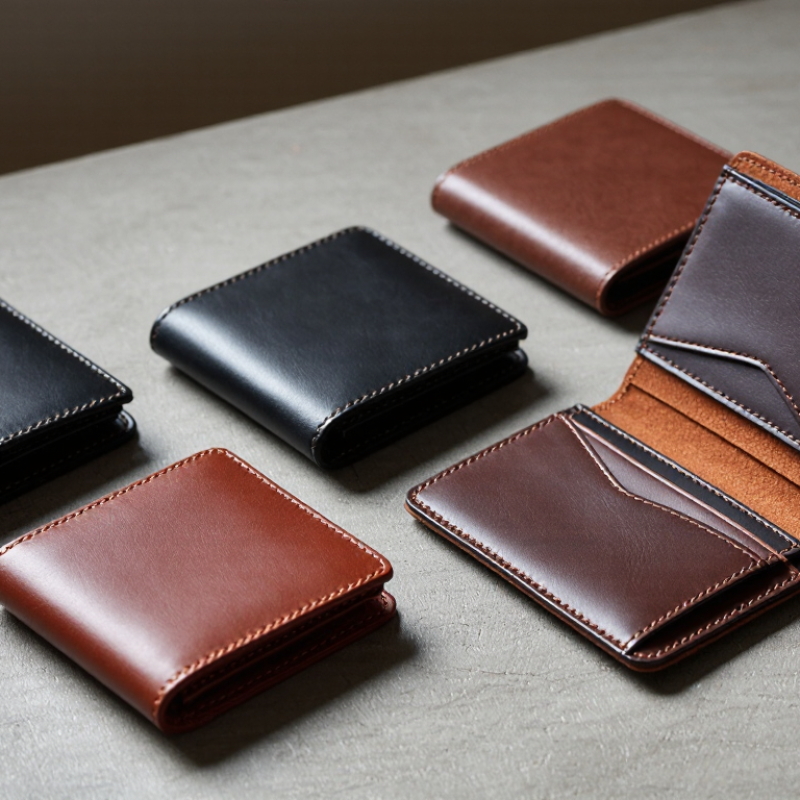
A reliable bi-fold leather wallet supplier in China should prove quality before discussing large orders. Ask for physical samples, not only polished product photos. Examine the leather grain, edge paint, lining, stitching, and fold flexibility by hand. A good wallet should close neatly without forcing the leather. Small details matter.
Professional suppliers explain their leather selection clearly. They can identify the material, thickness, finish, and expected aging process. They should also provide practical measurements, packaging options, and production timelines. During sampling, check card-slot tension and pocket alignment. These details often reveal more than a factory presentation.
Clear communication is equally important. Reliable suppliers respond with specific answers, confirmed drawings, and written quality standards. They should explain how workers inspect stitching, hardware, color consistency, and finished dimensions. A sample approval process reduces misunderstandings. So does an inspection report.
Experience has taught buyers to verify production capacity carefully. A supplier may handle samples well but struggle with repeated orders. Ask about monthly output, backup materials, and quality control records. Request references or independent inspection support when appropriate. No supplier is perfect. Even an experienced manufacturer can miss a minor edge flaw. The real test is how quickly and honestly the issue is handled. Building trust requires evidence, patience, and a willingness to question attractive promises.
Choosing a reliable supplier starts with the leather, not the price. Full-grain leather usually shows natural pores, subtle scars, and a firm, flexible feel. Correctly finished top-grain leather can also perform well. However, heavily coated leather may hide weak surfaces. Smell alone proves little.
Inspect a folded wallet in person. The leather should bend without sharp cracking or excessive stiffness. Check the edges closely. Clean edge painting, even folding, and secure stitching reveal careful workmanship. Thread should sit tightly inside each stitch hole. The card slots must hold cards firmly without becoming difficult to use. A sample may look excellent, yet production pieces can vary. This is where careful communication matters.
Tips: Request several samples from different production batches. Compare leather thickness, color, grain, lining, and thread tension. Ask for material specifications and practical test results, such as flexing and color-transfer checks. A dependable supplier should explain the leather source, construction method, inspection process, and acceptable tolerance. Do not judge craftsmanship from photographs only. Factory visits or independent inspections provide stronger evidence. I have found that small details often expose larger problems. A slightly uneven edge may reflect rushed finishing throughout the order. Still, perfection is unrealistic, so agree on clear quality standards before production begins.
China Best Bi Fold Leather Wallet Supplier?
How to Compare Chinese Suppliers, Prices, and Production Capabilities
A reliable comparison begins with product specifications, not the lowest quotation. Request leather type, thickness, lining material, dimensions, thread size, and edge-finishing details. A serious supplier should provide clear samples, production photos, and a written quality standard. Ask whether the sample uses the same materials planned for bulk production. It often does not.
Price differences usually reflect more than labor costs. Compare tooling, packaging, inspection, shipping terms, and minimum order quantities. A wallet quoted at a lower price may use thinner leather or faster edge paint. Request a cost breakdown. Then compare identical specifications. Keep records. Small details matter.
Production capability needs practical testing. Ask for monthly capacity, standard lead time, workshop equipment, and subcontracting arrangements. Review stitching consistency, folded edges, card-slot alignment, and logo placement on several samples. A factory may show one excellent piece. Request ten random units instead. My early supplier comparisons focused too heavily on price, and that mistake caused avoidable revisions. A better review checks sample quality, communication speed, payment terms, and corrective-action procedures together. Some factories offer impressive capacity figures, but their inspection records remain vague. That deserves a slower decision.
China Best Bi Fold Leather Wallet Supplier?
Customization, Private Label, and Packaging Options for Bi-Fold Wallets
A reliable supplier should turn a sketch into a practical wallet. Custom options may include leather type, color, stitching, edge paint, lining, and card-slot layout. Experienced factories can recommend leather thickness for durability and daily comfort. They should also provide material samples, measurement sheets, and pre-production prototypes. Small details matter. A loose stitch can damage the user’s experience.
Private label production requires more than adding a logo. The supplier should check artwork files, logo placement, embossing depth, and color accuracy before production. Clear approval records reduce misunderstandings. Ask about minimum order quantities, sample fees, production schedules, and inspection procedures. Factory photographs and production updates can improve transparency, but they should support real inspection, not replace it.
Packaging can be tailored for retail shelves, online shipping, or gift presentation. Options include paper sleeves, rigid boxes, cotton pouches, inserts, hangtags, and barcode labels. Recyclable materials may reduce unnecessary waste, while protective inserts help prevent surface scratches. In my sourcing experience, packaging is often discussed too late. That creates avoidable delays. A perfect wallet sample can still fail if its box is weak or oversized. Suppliers should confirm packaging dimensions, drop-test needs, printing proofs, and packing quantities before mass production. Some planning decisions may need revision after testing.
| Evaluation Dimension | Common Options | Typical Specification or Range | What Buyers Should Confirm |
|---|---|---|---|
| Wallet Construction | Classic bi-fold, slim bi-fold, billfold, coin-pocket bi-fold | Usually designed with 4–10 card slots, 1–2 bill compartments, and optional coin or ID pockets | Confirm the internal layout, pocket capacity, folding performance, and whether the wallet remains flat after loading |
| Leather Material | Full-grain leather, top-grain leather, corrected-grain leather, split leather, leather alternatives | Leather thickness commonly ranges from approximately 0.8–2.0 mm, depending on the construction and target price level | Request material descriptions, thickness measurements, surface samples, and confirmation of whether the material is genuine leather |
| Leather Finish | Natural grain, smooth, pull-up, embossed, pebbled, suede, vegetable-tanned | Finish selection affects appearance, scratch visibility, hand feel, color variation, and aging characteristics | Approve a physical color and texture sample before bulk production because screen colors may differ from the finished material |
| Custom Dimensions | Standard size, compact size, large bill size, custom proportions | A typical folded wallet measures approximately 9–12 cm in width and 8–10 cm in height, but dimensions vary by market and currency | Confirm unfolded dimensions, folded thickness, banknote compatibility, pocket fit, and tolerance requirements |
| Logo Customization | Debossing, hot stamping, screen printing, metal logo, woven label, laser engraving | Logo placement may include the exterior front, interior panel, coin pocket, or packaging; metallic foil is commonly available in several colors | Provide vector artwork and confirm logo size, position, color, depth, tooling charges, and approval sample requirements |
| Interior Lining | Leather, polyester, cotton, microfiber, nylon, unlined construction | Lining choice influences durability, flexibility, weight, cost, and the smoothness of card insertion | Check seam coverage, edge finishing, colorfastness, resistance to fraying, and compatibility with the selected leather |
| Edge Finishing | Painted edges, folded edges, burnished edges, raw edges | Well-finished edges should be even, securely bonded, and free from visible cracking, peeling, or excess adhesive | Specify edge color, number of coating layers, rounding requirements, and inspection standards for corners and folds |
| Hardware Options | Snaps, zippers, rivets, magnetic closures, metal badges, no hardware | Common hardware finishes include matte, polished, antique, gunmetal, silver-tone, and gold-tone | Confirm material, plating or coating, corrosion resistance, opening force, pull strength, and color consistency |
| Private Label Support | Custom logo, branded labels, custom care cards, barcode labels, product inserts | Private-label production normally requires approved artwork, packaging specifications, and a defined quality standard before mass production | Ask whether artwork setup, sampling, labeling, and packaging coordination are handled as separate services or included in the quotation |
| Typical Private-Label MOQ | Stock design with logo, modified design, fully custom design | Typical minimum quantities may range from about 100–500 pieces for stock-based customization and 500–2,000 pieces for more complex custom development | Confirm MOQ by color, leather type, logo method, packaging format, and size; small trial orders may carry setup surcharges |
| Sample Development | Existing sample, logo prototype, revised sample, pre-production sample | Sample development commonly takes approximately 7–20 working days, depending on material availability and design complexity | Confirm sample cost, revision limits, shipping responsibility, and whether the approved sample becomes the production reference |
| Bulk Production Lead Time | Repeat order, standard material, fully customized order | Production commonly requires approximately 25–60 working days after sample approval, deposit, and material confirmation | Request a written production schedule covering material sourcing, cutting, sewing, finishing, inspection, and packing |
| Packaging Options | Polybag, paper sleeve, kraft box, rigid gift box, drawer box, custom mailer | Packaging can include custom printing, tissue paper, stickers, care cards, hangtags, ribbons, and barcode labels | Confirm box dimensions, material thickness, printing method, drop protection, carton quantity, and packaging cost per unit |
| Sustainable Packaging | Recycled paper, FSC-certified paper, soy-based printing, reusable fabric pouch, reduced-plastic packaging | Paper-based packaging can reduce plastic use, while certification or recycled-content claims should be supported by documentation | Request material declarations or certification evidence when environmental claims are important to the sales channel |
| Quality Inspection | In-process inspection, final inspection, AQL-based inspection, third-party inspection | Inspection may cover dimensions, stitching, logo accuracy, leather defects, color consistency, hardware function, and packaging | Agree on acceptable defect levels, inspection timing, sampling quantity, corrective-action procedure, and photo-report requirements |
| Compliance Documentation | Material declaration, test report, restricted-substance documentation, packaging declaration | Documentation requirements depend on the destination market, product composition, packaging, and sales channel | Identify destination-country requirements before production and confirm which documents can be supplied for the finished product |
| Color Management | Standard color, Pantone reference, custom dyed leather, mixed-color assortment | Leather is a natural material, so slight variation in grain, shade, and surface markings can occur between hides or production batches | Approve a physical color standard and define acceptable color tolerance for leather, thread, lining, hardware, and packaging |
| Shipping Preparation | Individual packing, master cartons, palletized cartons, export labeling | Carton planning should account for product protection, dimensional weight, stacking strength, and destination labeling requirements | Confirm carton size, units per carton, gross and net weight, carton marks, shipping terms, and documentation responsibility |
| Best-Supplier Selection Criteria | Material transparency, sample accuracy, stable quality, communication, lead-time control, packaging capability | A suitable supplier should demonstrate consistent samples, clear specifications, documented inspections, and reliable production communication | Compare suppliers using the same specification sheet and evaluate samples before relying on price alone |
| The quantities, dimensions, lead times, and price-related production ranges above are typical industry benchmarks rather than guarantees. Final specifications depend on leather selection, design complexity, order volume, customization method, packaging requirements, and destination-market regulations. | |||
China Best Bi Fold Leather Wallet Supplier?
Quality control starts with a repeatable inspection plan, not attractive samples. Ask suppliers to record leather thickness, edge paint adhesion, stitch density, folding resistance, and hardware corrosion results. The International Organization for Standardization reported over 1.2 million valid ISO 9001 certificates worldwide in its 2022 survey. Certification helps, but it does not replace factory visits or independent inspections. A wallet can pass visual checks and still crack after repeated folding. Small details matter.
Request traceable material records, restricted-substance test reports, and batch photographs before shipment. Suppliers should identify leather origin, lining composition, and carton quantities clearly. Testing should reflect the destination market’s requirements, including chemical limits and labeling rules. Compliance documents must match the actual goods. Paperwork still fails. This is where buyers often rely too heavily on templates.
International shipping requires careful planning around Incoterms, customs descriptions, packaging dimensions, and insurance responsibility. UNCTAD reports that maritime transport carries more than 80% of global merchandise trade by volume, so port delays remain realistic. The World Bank’s 2023 Logistics Performance Index assessed 139 economies across customs, infrastructure, and shipment reliability. Build buffer time into production and transit schedules. A supplier may quote quickly, but delivery risk needs evidence. I would also test one smaller shipment first; it costs more per unit, yet exposes weak packing, inconsistent color, or missing documents before a larger order.
The chart compares selected substance limits that may affect leather wallet exports. Under EU REACH, chromium VI in leather articles that come into contact with skin must remain below 3 mg/kg. For products intended for children in the United States, the Consumer Product Safety Improvement Act limits lead in accessible parts to 100 ppm, equivalent to 100 mg/kg. Applicability depends on the destination market, product use, and material construction.
Supplier evaluation should also include material testing, stitching and hardware inspection, pre-shipment sampling, accurate customs documentation, Incoterms selection, and verification of the importer’s destination-country requirements.
Sources: EU REACH Regulation | U.S. CPSC Lead Content Limits
Request physical samples before discussing large orders. Handle the leather, edges, lining, stitching, and folding action. Photos are not enough. A reliable wallet should close neatly without forcing the leather.
The supplier should identify the leather type, thickness, finish, and aging expectations. Full-grain leather may show natural pores and small scars. Top-grain leather can also perform well. Smell alone proves little.
Check edge paint, stitch spacing, fold flexibility, and pocket alignment. Thread should sit tightly inside each stitch hole. Card slots should hold cards firmly. Small flaws can reveal rushed production.
Request several samples from different production batches. Compare their color, grain, thickness, lining, and thread tension. A perfect sample may not represent every finished wallet. That risk is easy to underestimate.
Ask for material specifications, confirmed drawings, measurements, tolerances, and production timelines. The supplier should explain inspection methods for stitching, hardware, color, and dimensions. Written standards reduce confusion. Verbal promises are weaker.
Confirm leather color, stitching, edge paint, lining, and card-slot layout. Request material samples, measurement sheets, and a pre-production prototype. For private labeling, approve artwork placement and embossing depth. Tiny changes can affect the final appearance.
Packaging may include paper sleeves, rigid boxes, cotton pouches, inserts, hangtags, or barcode labels. Confirm box dimensions, printing proofs, packing quantities, and protection requirements. Test whether the box survives handling. A beautiful wallet can still arrive scratched.
Ask about monthly output, backup materials, quality records, and inspection support. References can provide useful evidence. Independent inspection is stronger than factory photographs alone. No supplier is perfect. The response to mistakes matters more than perfect promises.
Choosing the best Bi-Fold Leather Wallet supplier in China requires more than comparing prices. A reliable supplier should offer consistent leather quality, precise stitching, durable hardware, and skilled craftsmanship. Buyers should evaluate leather types, finishing methods, sample quality, production capacity, lead times, and the supplier’s ability to maintain standards across large orders. Clear communication, transparent quotations, and responsive service are also important indicators of professionalism.
Chinese suppliers may provide customization, private labeling, personalized colors, logo placement, compartment layouts, and tailored packaging solutions. Before placing an order, buyers should confirm sampling procedures, quality-control checkpoints, inspection standards, and product documentation. It is also essential to discuss packaging protection, shipping arrangements, import requirements, and delivery schedules in advance. By carefully reviewing these factors, businesses can select a dependable partner capable of producing attractive, durable, and market-ready wallets that meet their specifications and international customer expectations.

Send your design, quantity and destination — our export team responds within one business day.